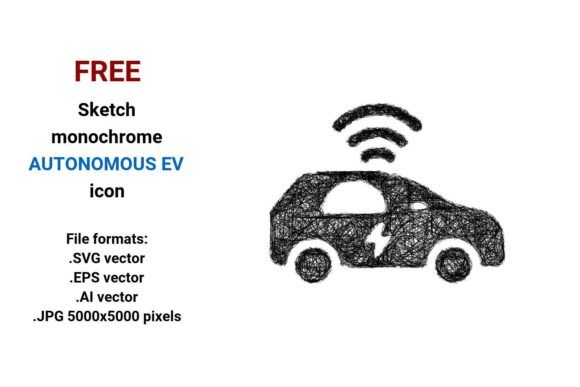
FREE Sketch Autonomous EV Icon: A Strategic Design Asset for the Self-Driving Era
In today’s rapidly evolving mobility landscape, visual language matters more than ever. As autonomous vehicle (AV) technology moves from R&D labs into real-world deployments—from robotaxis in San Francisco to self-driving delivery shuttles in logistics hubs—the need for clear, expressive, and adaptable design assets has surged. Enter the FREE Sketch Autonomous EV Icon: a purpose-built, hand-drawn vector resource that bridges technical precision with human-centered expression. More than just an icon, it’s a design signal—one that communicates autonomy, sustainability, and approachability in a single sketched outline.
What Is the FREE Sketch Autonomous EV Icon?
The FREE Sketch Autonomous EV Icon is a curated, royalty-free design asset representing the convergence of electric mobility and self-driving intelligence. Unlike generic flat icons or photorealistic renders, this set embraces an artistic, pen-drawn sketch aesthetic—evoking ideation, iteration, and human involvement in AI-driven systems. It comes in four production-ready file formats: .SVG vector, .EPS vector, .AI vector, and a high-resolution .JPG (5000×5000 pixels). Each format supports distinct workflows: SVG for responsive web interfaces, EPS and AI for print and branding refinement in Adobe Illustrator, and JPG for quick mockups, presentations, or social media visuals.
Crucially, this is a vector autonomous EV button—designed not only as a standalone symbol but as a functional UI element. Its clean line weight, balanced negative space, and subtle curvature make it ideal for dashboard controls, app navigation, infotainment overlays, and even physical HMI buttons in concept vehicles. The “sketched” quality isn’t decorative—it signals transparency, prototyping culture, and user-centric development—values increasingly prioritized by both consumers and regulators.
Why This Icon Fits Into Broader Industry Shifts
The rise of the self-driving EV isn’t just about hardware or algorithms—it’s about trust, comprehension, and integration. Studies from McKinsey and the Boston Consulting Group show that consumer adoption hinges less on technical specs and more on intuitive interaction and perceived safety. That’s where design becomes strategic. A handdrawn autonomous EV icon, for instance, softens the perceived coldness of automation. It doesn’t scream “robot takeover”; instead, it says, “this was imagined, tested, and refined—with you in mind.”
This aligns with macro trends across creative and tech sectors:
- Design Democratization: With tools like Figma and Webflow lowering barriers to UI/UX creation, professionals—from freelance designers to startup product managers—need plug-and-play assets that maintain brand integrity without demanding deep illustration skills. The FREE Sketch Autonomous EV Icon delivers immediate visual coherence for dashboards, pitch decks, and investor briefings.
- Sustainability Storytelling: EVs are no longer niche. But “electric” alone doesn’t convey intelligence—or responsibility. Pairing an autonomous EV icon with renewable energy visuals or circular economy messaging strengthens narrative alignment. Its pencil-outline style subtly reinforces eco-conscious craftsmanship over mass-produced sterility.
- Regulatory & Ethical Transparency: As governments draft AV deployment frameworks (e.g., EU’s AI Act, U.S. NHTSA guidelines), public-facing materials must demystify autonomy. An outline autonomous EV icon used in educational infographics or municipal transit apps helps normalize concepts like sensor fusion, geofencing, and L4 capability—without jargon.
Changing Workflows Demand Flexible, Human-Centered Assets
Modern design workflows are hybrid, fast-paced, and cross-disciplinary. A marketing lead building a campaign for an EV subscription service needs assets that work equally well in a Canva social post, a printed brochure, and an embedded interactive map. A UX researcher testing autonomous shuttle interfaces requires scalable vectors for Figma prototypes—and pixel-perfect JPGs for eye-tracking studies. A hardware engineer documenting a vehicle control module may embed the vector autonomous EV button directly into schematics or PCB layout notes.
That’s why format versatility matters. The .SVG vector scales infinitely for responsive dashboards; the .AI vector allows color overrides, stroke adjustments, and layer-based customization for brand alignment; the .EPS ensures compatibility with legacy prepress systems; and the 5000×5000 JPG offers crisp fidelity for large-format signage or investor slide backgrounds—no pixelation, no upscaling artifacts.
Moreover, the rough sketch icon aesthetic responds to a documented shift in user expectations: people increasingly distrust overly polished interfaces. Research published in the Journal of Consumer Psychology found users perceive hand-drawn elements as more honest, collaborative, and less manipulative—especially in contexts involving data, automation, or personal safety. In other words, a pen-drawn icon isn’t stylistic whimsy—it’s behavioral design.
Practical Use Cases Across Roles
For Product Managers: Embed the autonomous ev button in clickable Figma prototypes for stakeholder reviews. Its sketch style signals “work-in-progress,” inviting constructive feedback—not passive approval.
For Marketers: Layer the isolated, infographic sketch icon over urban mobility maps or charging network visuals. Its curved, organic lines contrast intentionally with rigid grid layouts—guiding attention while reinforcing innovation.
For Educators & Policy Advocates: Use the line autonomous EV icon in open-access toolkits explaining AV levels (SAE J3016). Its simplicity makes it accessible to K–12 students and community groups alike—no prior tech literacy required.
For Freelance Designers: Bundle the FREE Sketch Autonomous EV Icon with complementary assets (e.g., charging station sketches, sensor array outlines) to create premium UI kits for automotive clients—adding tangible value beyond stock libraries.
Connecting to Larger Developments—Without Speculation
The self-driving vehicle ecosystem is maturing—not toward sci-fi singularity, but toward pragmatic integration. We see it in fleet operators adopting Level 2+ ADAS as standard, in cities redesigning curb zones for AV drop-offs, and in insurance models shifting from driver-risk to software-certification frameworks. In each case, communication is infrastructure. Icons aren’t decoration—they’re micro-interfaces that shape perception, reduce cognitive load, and accelerate shared understanding.
This is why the FREE Sketch Autonomous EV Icon stands out: it meets current needs without chasing hype. It doesn’t pretend to visualize quantum computing or neural lace—it focuses on what’s deployable, understandable, and humanly resonant today. Its artistic, isolated, sketched form avoids visual fatigue common with overused flat-icons, while its vector autonomous ev foundation ensures longevity across platforms and screen densities.
Importantly, it reflects a broader industry pivot—from “building the future” to “designing the transition.” That means interfaces that acknowledge uncertainty, visuals that invite questions rather than demand compliance, and symbols that honor both engineering rigor and lived experience. A handdrawn autonomous EV icon does exactly that: it’s precise enough for engineers, warm enough for riders, and flexible enough for tomorrow’s unknowns.
Final Thought: Design as a Bridge, Not a Billboard
As autonomous mobility moves from prototype to policy, from lab to lane, every visual touchpoint carries weight. The FREE Sketch Autonomous EV Icon succeeds because it refuses to choose between function and feeling. It’s a vector autonomous EV button built for usability, yet rendered with the authenticity of a pencil and pen. It’s clean but not sterile, curved but not frivolous, isolated yet context-aware. For professionals shaping how people interact with self-driving systems—whether through code, policy, storytelling, or interface—it’s not just another download. It’s a quiet, confident statement: that the most advanced technologies still need human hands to guide them—and human eyes to recognize them.
Whether you’re iterating on a dashboard layout, designing a UI button for a mobility app, or illustrating an infographic sketch icon for a sustainability report, this asset meets you where you are—scalable, semantic, and sincerely made.