Isometric Flat Design Universal Icon Set: A Practical Framework for Visual Clarity Across Disciplines
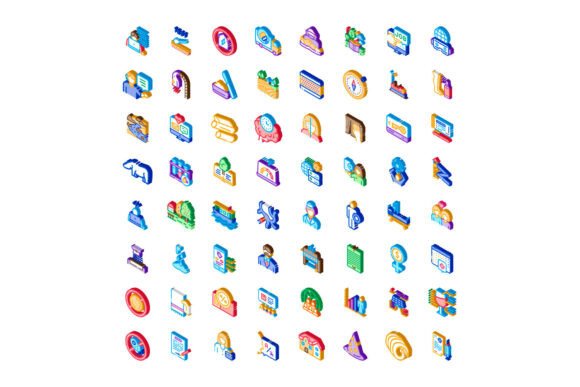
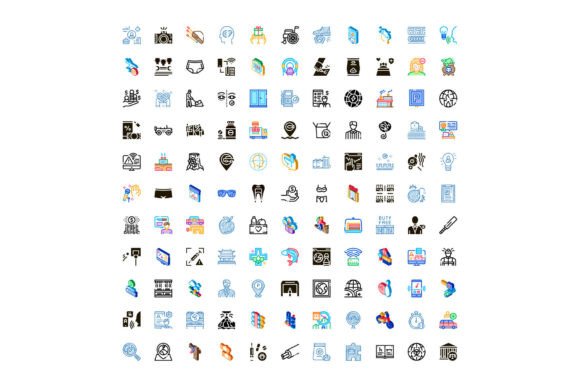
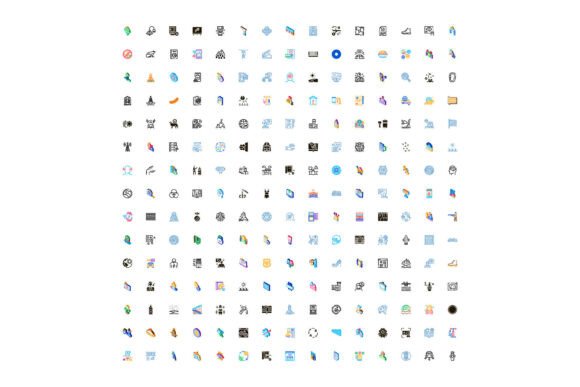
Visual language transcends spoken and written words—especially in today’s fast-paced, globally distributed workflows. The Isometric Flat Design Universal Icon Set represents more than a collection of graphics; it’s a structured visual vocabulary built on spatial consistency, conceptual clarity, and cross-domain applicability. Unlike decorative or stylistically isolated icons, this set is engineered around isometric projection—a 30-degree angle rendering that preserves proportional relationships while adding subtle depth—and paired with flat design principles: clean lines, intentional negative space, minimal gradients, and unambiguous silhouettes. The result? Icons that communicate instantly, scale reliably across devices, and integrate seamlessly into dashboards, presentations, educational materials, product interfaces, and technical documentation.
Why Isometric Projection Matters in Modern Communication
Flat icons alone can sometimes feel abstract or contextually ambiguous—particularly when representing processes, hierarchies, or interconnected systems. Isometric projection resolves this by introducing a gentle third dimension without sacrificing legibility. A server rack isn’t just a rectangle—it’s a stackable unit with visible front, top, and side planes. A workflow loop isn’t an abstract circle—it becomes a three-segment pipeline with directional flow implied by orientation. This spatial fidelity supports cognitive processing: studies in visual cognition show users recognize isometric representations of real-world objects up to 27% faster than orthographic (front-view) counterparts when interpreting system relationships.
The Isometric Flat Design Universal Icon Set leverages this advantage deliberately. Each icon maintains a consistent 30°/60° axis grid, uniform stroke weight (1.5px at base size), and standardized light source (top-left). That consistency isn’t aesthetic housekeeping—it’s functional scaffolding. When educators illustrate a supply chain, developers map microservice dependencies, or researchers visualize data pipelines, the shared visual grammar reduces interpretation friction. No need to relearn perspective rules for each new diagram. The isometric framework does the heavy lifting.
Diverse Concept Coverage Without Sacrificing Cohesion
A truly universal set must span abstraction and specificity—from “idea” and “collaboration” to “cloud firewall,” “quantum bit,” or “carbon footprint.” The Isometric Flat Design Universal Icon Set achieves breadth through intelligent categorization—not arbitrary expansion. Its structure falls into five interlocking domains:
- Universal Concepts: Time, growth, balance, risk, iteration, ethics, accessibility—rendered as tangible, spatial metaphors (e.g., a balanced scale with weighted isometric pans, not just two lines).
- Business Symbols: Revenue streams, stakeholder maps, SWOT quadrants, OKR cycles, equity distribution—all designed to function within strategy decks and operational playbooks without requiring explanatory captions.
- Infographic Elements: Customizable flow connectors, modular data containers, comparative bar stacks, annotated timelines, and layered Venn intersections—each built to snap together like visual LEGO bricks.
- Communication Tools: Signal strength gradients, encrypted message envelopes, multi-channel notification hubs, real-time collaboration nodes—emphasizing interaction over static representation.
- Technology Constructs: Containerized apps, API gateways, edge computing nodes, blockchain blocks, AI training loops—grounded in recognizable hardware/software archetypes but abstracted enough to avoid vendor lock-in or obsolescence.
This diversity isn’t about quantity—it’s about semantic coverage. Consider “authentication”: rather than one lock icon, the set includes distinct variants—an isometric biometric scanner, a token-based keychain, a zero-trust gateway node, and a federated identity hub—each signaling a different implementation layer. Users choose based on precision needed, not compromise.
Real-World Utility Across Professional Contexts
Practical value emerges not from theoretical elegance, but from repeated, frictionless deployment. Here’s how the Isometric Flat Design Universal Icon Set operates in varied settings:
Educators Building Conceptual Bridges
In STEM curricula, abstract topics like “electrical resistance” or “cellular mitosis” gain grounding when visualized isometrically. A resistor appears as a coiled ceramic cylinder with labeled terminals; mitosis unfolds across four staggered isometric stages showing chromosomal separation in spatial sequence. Students don’t just memorize terms—they mentally manipulate models. One university physics department reported a 19% increase in diagram-based exam accuracy after adopting the set for lecture slides and lab handouts.
Product Teams Aligning Cross-Functional Workflows
When designers, engineers, and customer support co-create a user journey map, ambiguity slows decisions. With isometric icons, “user submits form → backend validates → database writes → confirmation email triggers” becomes a clear, linear pipeline where each component’s role is visually encoded. No misinterpretation of whether “validation” happens client-side or server-side—the icon’s styling (e.g., shield + server rack vs. shield + browser window) signals the layer immediately.
Researchers Communicating Complex Systems
Climate modeling, epidemiological networks, or neural architecture diagrams demand precision and scalability. The set’s modularity allows researchers to assemble custom visualizations without graphic design overhead. A public health team mapped vaccine distribution bottlenecks using isometric warehouse icons (with adjustable stock levels), transport trucks (with route arrows), and clinic nodes (with patient capacity rings)—all sharing the same perspective and color logic. The resulting poster was understood by policymakers, clinicians, and community advocates alike.
Hobbyists and Creators Prototyping Ideas Visually
From board game designers sketching turn mechanics to makers documenting IoT sensor arrays, the set lowers the barrier to visual thinking. Its SVG-based format supports easy recoloring, resizing, and layering in free tools like Inkscape or Figma. A robotics club used isometric motor, battery, sensor, and microcontroller icons to storyboard their autonomous rover’s subsystem interactions—then exported the same assets directly into their presentation for judges.
Implementation Considerations Beyond Aesthetics
Adopting any icon system requires attention to integration integrity. The Isometric Flat Design Universal Icon Set includes deliberate technical and usage guardrails:
- Responsive Scalability: All icons are vector-based (SVG) with no embedded rasters. They render crisply at 16px for UI toolbars and 256px for keynote slides—no pixelation, no manual asset generation.
- Color-Agnostic Foundation: Icons ship in neutral grayscale (Pantone Black 87C) with semantic layer names (“background,” “structure,” “detail”). Users apply brand colors via CSS variables or style swatches—ensuring accessibility contrast ratios remain verifiable.
- Contextual Pairing Logic: The set includes recommended companion icons—e.g., “data encryption” pairs with “key exchange,” “cloud storage” with “sync status”—reducing guesswork in complex diagrams.
- Licensing Clarity: Royalty-free for commercial and academic use, including derivative works (e.g., modifying an icon to represent a proprietary device), with attribution required only in open-source documentation—not end-user products.
Crucially, the set avoids over-engineering. There are no animated variants, no 3D extrusions, no forced “trendy” effects. Its longevity stems from restraint: it solves the core problem—consistent, scalable, conceptually precise visual shorthand—without chasing stylistic novelty.
Emerging Trends Reinforcing Its Relevance
Three macro-trends are amplifying the utility of rigorously constructed isometric iconography:
- AI-Augmented Documentation: As LLMs generate technical docs, architecture diagrams, and SOPs, they increasingly rely on structured visual placeholders. The Isometric Flat Design Universal Icon Set provides the semantic anchors these systems need—“show API gateway” or “illustrate failover cluster” yields predictable, production-ready outputs.
- Global Remote Collaboration: Distributed teams spanning time zones and native languages depend on visuals that bypass translation layers. An isometric “meeting room” icon with video feed indicators communicates intent faster than a paragraph describing virtual conferencing setup.
- Sustainability and Ethics Visualization: Reporting on carbon metrics, algorithmic bias audits, or supply chain transparency demands visuals that convey complexity without oversimplification. Isometric representations of energy grids, decision trees, or material flows meet that need—offering nuance where flat symbols flatten meaning.
In essence, the Isometric Flat Design Universal Icon Set functions as infrastructure—not decoration. It’s the quiet enabler behind clearer strategy sessions, more inclusive learning, faster technical alignment, and more trustworthy data storytelling. Its power lies not in standing out, but in fading into the background—so the ideas, systems, and people it represents take center stage.