Neurology Medical Vector Icons: Precision Design for Clarity in Health Communication
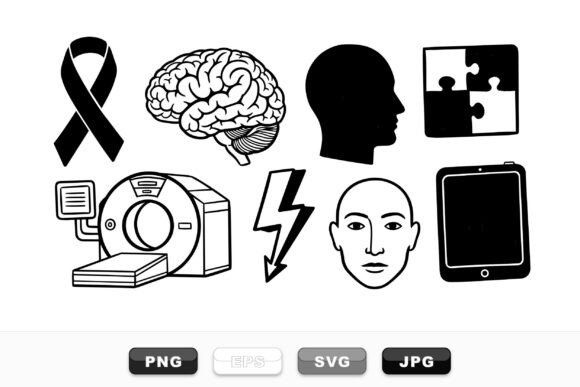
At the intersection of neuroscience, digital design, and health literacy lies a quietly transformative resource: Neurology Medical Vector Icons. This minimal line art vector set is not merely a collection of illustrations—it’s a purpose-built visual language for professionals who communicate complex neurological and mental health concepts with accuracy, empathy, and efficiency. Designed for editorial use, data-driven infographics, clinical apps, patient education tools, and telehealth interfaces, it delivers clarity without compromise.
A Toolkit Built for Today’s Health Communication Challenges
In an era where public understanding of brain health, neurodiversity, and mental wellness is rapidly evolving, visual communication must keep pace—not just stylistically, but semantically. Generic medical icons often conflate conditions, oversimplify mechanisms, or rely on outdated metaphors (e.g., cartoonish “lightbulb” brains or stereotyped “sad face” emoticons). Neurology Medical Vector Icons avoids those pitfalls by grounding each glyph in anatomical fidelity and clinical nuance—depicting functional regions like the prefrontal cortex, hippocampal formation, or basal ganglia; representing modalities such as EEG, fMRI, and transcranial stimulation; and illustrating evidence-informed concepts like neuroplasticity, synaptic pruning, and circadian rhythm regulation.
This precision matters because ambiguity has real-world consequences. A marketer designing a mental health app onboarding flow needs to distinguish between “anxiety management” and “panic disorder support.” A researcher preparing a grant-funded infographic on dementia prevention must visually differentiate amyloid plaques from tau tangles. A clinician building a bilingual patient handout on migraine triggers requires scalable, culturally neutral symbols that translate across literacy levels—and screen sizes. Neurology Medical Vector Icons meets these demands through intentional minimalism: clean lines, consistent stroke weight, balanced negative space, and deliberate abstraction that prioritizes recognition over ornamentation.
Fitting Into Broader Creative and Technological Shifts
The rise of this vector set reflects larger industry currents. First, there’s the democratization of health content creation. More professionals—from freelance UX designers crafting behavioral health dashboards to nonprofit communicators launching anti-stigma campaigns—are producing original health materials. They need production-ready assets that comply with accessibility standards (e.g., sufficient contrast, SVG-based scalability), integrate seamlessly into Figma or Adobe XD workflows, and avoid licensing friction. The downloadable ZIP—including SVG, EPS, JPG, and PNG files—ensures cross-platform compatibility without sacrificing fidelity.
Second, it aligns with the growing expectation for contextual accuracy in digital health. Consumers are more informed than ever. They read peer-reviewed summaries on PubMed Central, follow neurologists on social media, and compare treatment options using AI-powered symptom checkers. As a result, stock imagery and generic clipart no longer suffice. Audiences notice when a “depression icon” misrepresents limbic circuitry—or when a “neurofeedback” graphic implies direct brain-to-computer control rather than measured biofeedback loops. Neurology Medical Vector Icons anticipates this shift by collaborating with clinical advisors during development, ensuring icon semantics reflect current consensus—not legacy conventions.
Third, it supports the expansion of remote and hybrid care models. With telepsychiatry visits up 300% since 2020 and digital therapeutics gaining FDA clearance at scale, visual consistency across touchpoints is critical. Whether embedded in a HIPAA-compliant EHR interface, animated in a patient-facing explainer video, or printed on a laminated cognitive behavioral therapy worksheet, these icons maintain legibility and meaning across resolutions and contexts. Their minimal line art aesthetic also renders well in low-bandwidth environments—important for rural clinics or global health NGOs deploying offline-first tools.
Why Professionals Are Prioritizing Visual Rigor Over Visual Novelty
It’s not that novelty lacks value. But in health communication, novelty without grounding can erode trust. Consider two scenarios:
- A startup founder developing a mindfulness app for teens uses playful, colorful brain icons—but fails to distinguish between attentional networks and default mode network activity. Early users report confusion about how breathwork “resets the brain,” leading to lower engagement in guided sessions.
- A university medical communications team adopts Neurology Medical Vector Icons for their open-access neuroscience primer series. Because each icon maps clearly to established terminology (e.g., “dopaminergic pathway” vs. “serotonergic modulation”), educators report fewer student questions about symbolic meaning—and more time spent discussing mechanism and evidence.
The difference isn’t artistic preference—it’s functional alignment. When creators invest in semantically precise assets, they reduce cognitive load for their audience, increase information retention, and signal professional credibility. That’s why designers at institutions like the National Institute of Mental Health, startups in the digital therapeutics space, and editorial teams at journals like Neurology Today increasingly curate icon libraries not by style alone, but by clinical coherence.
Practical Integration Across Workflows
What makes Neurology Medical Vector Icons especially valuable is its adaptability across roles and stages of production:
- For marketers: Use SVG versions to dynamically recolor icons based on brand palettes—essential for A/B testing landing page variants focused on different therapeutic areas (e.g., epilepsy awareness vs. Parkinson’s disease education).
- For developers: Embed SVGs directly into React or Vue components with accessible
aria-labelattributes, ensuring screen readers announce intent (“icon representing neural connectivity map”) rather than decorative noise. - For clinicians and educators: Print high-resolution PNGs for laminated classroom posters or export EPS files for inclusion in peer-reviewed figure submissions—without worrying about pixelation or font embedding issues.
- For freelancers: Leverage the consistent grid system and uniform baseline across all icons to build custom icon sets in under five minutes—say, combining “sleep architecture,” “circadian phase,” and “melatonin receptor” for a sleep medicine presentation.
Crucially, the set avoids visual overload. There are no gratuitous shadows, gradients, or skeuomorphic details. Every curve serves recognition. Every negative space invites focus. That restraint isn’t minimalism for its own sake—it’s usability engineering.
Looking Ahead: Clarity as Infrastructure
As artificial intelligence accelerates the generation of health content—from automated patient summaries to multilingual chatbot responses—the foundational role of human-curated, clinically grounded visual assets becomes even more vital. AI can draft text, but it cannot yet reliably interpret the semantic weight of a correctly proportioned corpus callosum icon versus a stylized “brainstorm” motif. Human designers remain indispensable gatekeepers of meaning—and tools like Neurology Medical Vector Icons extend that stewardship into scalable, reusable form.
This isn’t about replacing creativity. It’s about elevating it. When professionals spend less time reverse-engineering inaccurate stock graphics or defending icon choices to clinical reviewers, they gain bandwidth to focus on narrative structure, cultural adaptation, and user-centered testing. In that sense, Neurology Medical Vector Icons functions less like decoration and more like infrastructure—quiet, reliable, and essential.
Whether you’re mapping neural pathways in a TED-Ed script, designing a mobile CBT journal, or illustrating a policy brief on equitable access to neuropsychological assessment, clarity isn’t optional. It’s the first step toward understanding—and understanding is where healing, learning, and innovation begin.