Progress Timeline PowerPoint Template
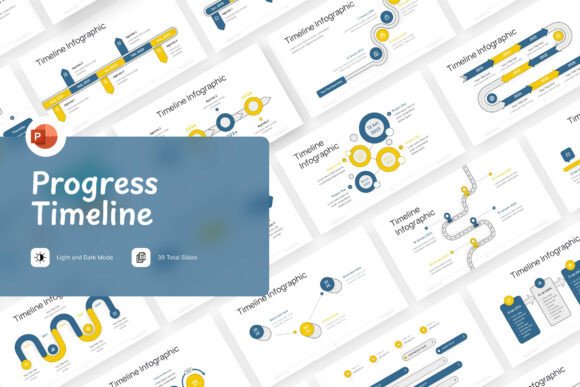
A well-structured progress timeline isn’t just a visual aid—it’s a decision-making anchor. The Progress Timeline PowerPoint Template serves this role with precision: it transforms abstract effort into visible, measurable movement. Unlike generic slide decks that summarize outcomes after the fact, this template is built for active use—before launch, during execution, and in post-project reflection. It belongs in the toolkit of anyone who plans, coordinates, teaches, sells, builds, or grows—not as decoration, but as infrastructure.
Where It Fits in Real Workflows
This isn’t a “one-and-done” presentation asset. The Progress Timeline PowerPoint Template integrates across phases:
- Before action: Use it to map milestones, assign ownership, align stakeholders, and pressure-test feasibility. A timeline sketched early reveals bottlenecks—like overlapping dependencies or unrealistic handoffs—before resources are committed.
- During execution: Update it weekly (or per sprint) to reflect actual status—not idealized projections. Color-coded stages (e.g., “In Review,” “Blocked,” “Approved”) keep teams grounded in shared reality, not assumptions.
- After completion: Repurpose the same timeline to demonstrate impact—comparing planned vs. actual dates, highlighting delays with context (not blame), and linking outcomes to specific interventions.
For educators, it structures lesson sequencing across semesters. For freelancers, it replaces fragmented email updates with a single, living reference clients can check autonomously. For product teams, it syncs engineering, design, and marketing calendars without requiring new software.
Designed for Consistency, Not Just Looks
The template includes 15 unique slides and 90 XML files—meaning every variation (quarterly review, sprint breakdown, campaign rollout, curriculum map) shares underlying logic and styling. That consistency matters. When your sales deck uses the same color logic, spacing rhythm, and icon language as your internal ops report, audiences absorb information faster and trust the message more.
Custom MS Office theme colors ensure brand alignment without manual overrides. Whether you’re using a corporate palette or a personal brand scheme, the template adapts—no hex-code hunting or inconsistent shading. The widescreen 16:9 format fits modern projectors, Zoom share screens, and exported PDFs without cropping or scaling distortion.
How It Works With Your Existing Tools
You don’t need to replace your current stack to benefit from the Progress Timeline PowerPoint Template. It complements—not competes with—other systems:
- Project management tools: Pull status data from Asana, ClickUp, or Jira into the timeline for stakeholder-facing summaries. Keep granular task tracking where it lives; use the template for high-level narrative.
- Brand assets: Drop in your own logos, fonts, and image libraries. All icons and shapes are fully editable vector elements—not flattened PNGs—so resizing or recoloring preserves quality.
- Collaboration platforms: Save versions directly to SharePoint or Google Drive. The light/dark versions let presenters switch modes based on room lighting or accessibility needs—no redesign required.
- Reporting workflows: Export individual slides as SVG or PNG for inclusion in dashboards, newsletters, or client portals. The Help Guide file walks through batch-export settings and font embedding tips.
No plug-in, no cloud dependency, no subscription. It runs natively in PowerPoint—so if your organization restricts third-party apps or works offline, this stays reliable.
Practical Implementation Tips
Start small. Don’t try to map an entire fiscal year on day one. Instead:
- Pick one recurring process—like onboarding new team members—and build a 6-step timeline using only the core slides.
- Test it with two people: one familiar with the process, one new. Note where terminology confuses or where timing feels arbitrary.
- Iterate once—adjust durations, rename stages, add a “Risks” column—then lock the structure.
- Re-use that version across all future onboarding cycles. Track how often edits are needed over three months. If changes drop below 10%, you’ve hit stability.
When customizing, prioritize clarity over creativity. Avoid animated transitions or layered effects—they distract from progress signals. Instead, use the built-in status indicators: green = complete, amber = in progress, red = delayed—with optional callouts for root cause (e.g., “Vendor delay,” “Scope revision approved”). These tiny additions turn passive visuals into active communication tools.
Long-Term Usability Considerations
A template’s real value shows up over time—not its first use, but its tenth. The Progress Timeline PowerPoint Template supports longevity through deliberate design choices:
- Organization: Slides are named descriptively (“Q3 Milestone Map,” “Phase 2 Dependency View”)—not “Slide 7” or “Timeline_v2_final_FINAL.” This makes searching and reusing intuitive, even months later.
- Efficiency: XML files let you swap entire color schemes or typography sets with one click. Need a version for a dark-mode webinar? Switch to the dark variant—no rebuilding from scratch.
- Quality control: All infographics are handmade—not AI-generated placeholders. Lines align precisely, text scales cleanly, and icons follow consistent stroke weights. This avoids the “almost right” look that erodes credibility in formal settings.
- Compatibility: Built for Microsoft PowerPoint 2019 and newer—including Microsoft 365. Tested on both Windows and macOS. No missing fonts or broken layouts when shared cross-platform.
And because image stocks aren’t included, you retain full control over licensing and relevance—no surprise copyright flags in client deliverables.
Who Benefits Most—and How
Entrepreneurs use it to visualize runway-to-revenue paths for investors—mapping hiring, product launches, and funding rounds on one coherent axis. Marketers align campaign phases (awareness → consideration → conversion) with channel-specific KPIs, making cross-channel reporting transparent. Educators break semester-long learning objectives into digestible segments, helping students see how Week 4 connects to Final Project delivery.
Freelancers embed timelines directly into proposals—not as vague “phases,” but as date-bound commitments with defined deliverables and approval gates. Small business owners track seasonal initiatives (e.g., holiday inventory prep, tax filing prep, staff training) without switching between spreadsheets and calendars.
Even hobbyists benefit: planning a home renovation, organizing a community event, or documenting a skill-building journey (e.g., “30 Days of Python”) becomes more intentional when progress is visible, not just felt.
Final Thought: It’s About Shared Understanding
The strongest timelines don’t impress—they clarify. They reduce ambiguity, surface misalignment early, and give everyone involved the same frame of reference. The Progress Timeline PowerPoint Template delivers that by removing friction—not adding features. It assumes you already know your work. Its job is to help others understand it, quickly and accurately.
That’s why preparation matters more than polish. Spend 20 minutes defining your key milestones before opening the file. Decide what “done” means for each stage—not just “submitted,” but “approved by legal and live on site.” Then drop those definitions into the template. The rest—the layout, the colors, the pacing—is already resolved.
Use it not to show how far you’ve come, but to agree on where you’re going—and how you’ll know when you arrive.