Rotten Food Waste Landing Header Vector
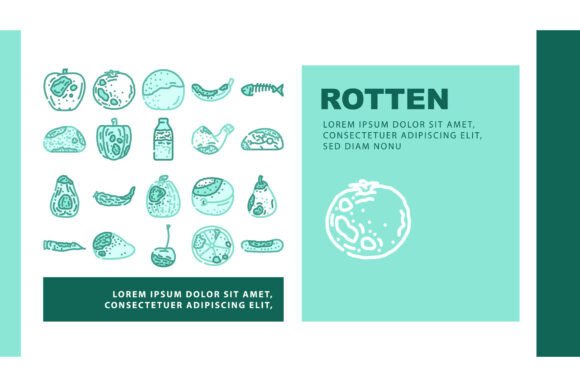
Imagine opening a presentation slide on food sustainability—and landing instantly on a crisp, expressive icon of wilted lettuce, mold-speckled berries, or a cracked egg oozing gray-green decay. That’s the impact of the Rotten Food Waste Landing Header Vector: a purpose-built visual anchor designed not just to depict spoilage, but to communicate urgency, awareness, and nuance—without a single word.
This isn’t generic clip art. It’s a curated vector set rooted in observation and intention—each illustration drawn with deliberate line weight, consistent scale, and subtle textural cues (like faint stippling on rotting fruit or fine cross-hatching on spoiled dairy). The clean line-art style ensures clarity at any size, from social media thumbnails to large-format exhibition banners. And because it’s fully vector-based, it scales infinitely without pixelation, resizes smoothly in design software, and adapts effortlessly to light or dark backgrounds.
Why This Matters—Differently—for Different People
What makes this set resonate across roles isn’t uniformity—it’s flexibility. A high school science teacher doesn’t need the same features as a zero-waste startup founder. Yet both find value—not because the icons are “perfect for everyone,” but because they’re built to serve distinct goals without compromise.
For Educators & Curriculum Designers
You’re building a lesson on decomposition, food systems, or climate impact. Students respond better to visuals that feel authentic—not cartoonish, not clinical, but recognizably *real*. With the Rotten Food Waste Landing Header Vector, you can pair an illustration of slimy spinach with a short caption about microbial growth rates—or use the composting banana peel icon alongside a diagram of nutrient cycling. No licensing guesswork. No pixelated screenshots pulled from Google Images. Just ready-to-drop, classroom-ready vectors that support learning—not distract from it.
For Marketers & Content Creators
You’re drafting a blog post titled “5 Hidden Causes of Household Food Waste” or designing an Instagram carousel for a grocery delivery app’s sustainability initiative. Visual consistency matters. Readers scroll fast—but they pause when something feels intentional. The line-art style unifies your messaging: it’s modern enough for a tech audience, grounded enough for community advocates, and neutral enough to avoid unintended tone (no exaggerated grins on rotting tomatoes, no sensationalized decay). You can recolor icons in seconds to match brand palettes—or layer them over photos for editorial depth.
For Small Business Owners & Sustainability Coordinators
You run a local café, a meal-kit service, or a municipal compost program. Your presentations go to city councils, investors, or volunteer teams—each needing clarity, not clutter. The header vector works as a focal point on a one-pager explaining spoilage reduction strategies. The individual icons help label bins (“Fruit & Veg,” “Dairy,” “Cooked Leftovers”) with visual shorthand that transcends language barriers. Because the files are SVG and AI-ready, you drop them into Canva, Figma, or Adobe Illustrator without wrestling with raster imports or font dependencies.
For Freelancers & Designers
You’re building a client’s environmental report, a nonprofit’s annual impact deck, or an infographic for a food rescue NGO. Time is finite. You need assets that integrate cleanly—not ones requiring hours of cleanup, tracing, or stylistic overrides. These vectors ship with grouped layers, named paths, and logical layer structures. Want to isolate the stem of a rotten apple? It’s editable as a separate path. Need to adjust stroke width globally? One setting change does it. That kind of thoughtful construction saves time—and builds trust with clients who notice polished details.
What Priorities Actually Matter—And Why They Vary
Not every user weighs features the same way. A student making their first infographics cares more about ease of use than commercial license breadth. A publisher launching a paid educational toolkit needs clear attribution rules and scalability across print and digital. Here’s how real-world priorities map to practical reality:
- Ease of use: Beginners benefit most from drag-and-drop compatibility in tools like Canva or PowerPoint—no Illustrator required. These vectors include optimized SVG exports that retain editability even in simplified editors.
- Flexibility: Designers and agencies rely on layered .AI and .EPS files to tweak stroke alignment, adjust negative space, or export subsets for custom icon systems.
- Presentation readiness: Educators and presenters look for cohesive styling—consistent stroke weight, balanced proportions, and intuitive grouping—so icons don’t compete visually on a slide.
- Long-term usefulness: Anyone building reusable templates (e.g., quarterly sustainability dashboards) values timeless style over trend-driven aesthetics. Line art avoids dating quickly—and avoids clashing with future brand refreshes.
- Creative spark: Hobbyists and illustrators sometimes use these as base references—tracing over outlines to study decay patterns, then reinterpreting them in watercolor or 3D modeling. The fidelity supports reinterpretation, not just replication.
Real Projects, Real Decisions
A food blogger uses the rotten avocado icon to introduce a post on “How to Store Avocados Without Waste”—then reuses the same vector (in grayscale) as a watermark on Pinterest pins. No extra cost. No permission hurdles.
A university extension office embeds the tomato and bread icons into a printable “Home Food Waste Audit” worksheet—then shares the PDF freely with partner farms and schools. The clean lines ensure legibility even when printed on recycled paper.
A UX designer prototyping a smart-fridge app interface uses the vector set to visualize “spoilage alerts” in early wireframes—knowing the final UI team can hand off directly to development using the same scalable assets.
None of these users needed animation, photorealism, or 3D depth. What they needed was accuracy, adaptability, and respect for their time and intent.
Does This Fit Your Next Step?
If you’re weighing whether the Rotten Food Waste Landing Header Vector aligns with your work, ask yourself:
- Do I need visuals that communicate food waste without oversimplifying or sensationalizing it?
- Will I use these across multiple formats—presentations, web graphics, print handouts, or digital reports?
- Do I prefer working with clean, editable vectors over low-res PNGs or restrictive stock licenses?
- Is consistency across my materials important—whether I’m teaching, reporting, advocating, or designing?
If yes to two or more, this set likely fits—not as a “one-size-fits-all solution,” but as a thoughtfully constructed tool shaped by real use cases, not stock trends.
It won’t replace field research or policy analysis. But it can make those efforts clearer, more accessible, and more memorable—to students, stakeholders, customers, and communities alike.