Drone Flight Control Clipart: A Versatile Design Resource for Educators, Makers, and Professionals
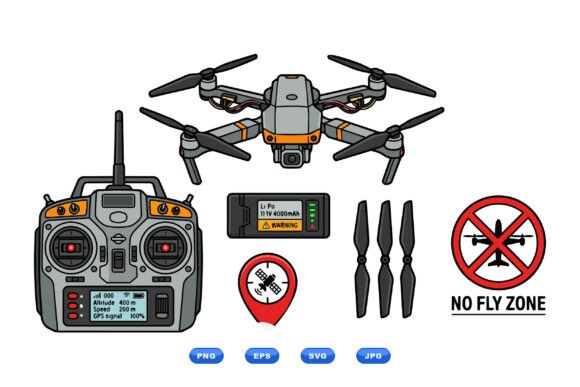
Whether you're designing an instructional flyer for a drone safety workshop, creating a step-by-step guide for beginner pilots, or developing packaging for a new RC kit, drone flight control clipart offers a clean, scalable, and instantly usable visual solution. This particular collection features a flat design vector set centered around a neutral, professional aesthetic—featuring a gray-and-orange quadcopter, a handheld controller, rechargeable battery, detachable propellers, and a universally recognized "no fly" icon. Arranged thoughtfully for infographic use, it’s built not just to look good—but to communicate clearly.
What Exactly Is Drone Flight Control Clipart?
Drone flight control clipart refers to a curated set of ready-to-use digital illustrations that visually represent the core hardware and regulatory elements involved in operating unmanned aerial vehicles (UAVs). Unlike generic drone images or photorealistic renders, this collection prioritizes clarity over complexity: simplified shapes, consistent line weights, intentional color contrast (gray for structure, orange for emphasis), and purposeful negative space—all hallmarks of effective flat design.
This isn’t decorative art—it’s functional visual communication. Each element is drawn with technical accuracy and instructional intent: the quadcopter shows symmetrical motor placement; the controller includes recognizable analog sticks and buttons; the battery displays standard connector orientation; the propellers are labeled clockwise/counterclockwise for safe installation; and the no-fly icon uses ISO-aligned geometry for instant recognition.
Why Flat Design Matters for Technical Illustration
Flat design eliminates visual noise—no shadows, gradients, or textures that could distract from key information. That makes it ideal for:
- Educational materials — Students learning drone mechanics can focus on component relationships without interpreting lighting or perspective.
- Safety signage — Regulatory icons like “no fly zones” must be legible at a glance and across varied print sizes.
- DIY and maker projects — Cricut and Silhouette users need crisp vector paths for precise cutting; flat vectors convert flawlessly to physical media.
- Multi-format publishing — Whether scaled down for a mobile app icon or enlarged for a trade show banner, flat vectors retain sharpness and readability.
How This Clipart Set Supports Real-World Applications
This collection goes beyond aesthetics—it bridges digital design and tangible utility. The included formats ensure seamless integration across platforms and production methods:
- SVG and EPS files — Fully editable, resolution-independent vectors perfect for designers using Adobe Illustrator, Affinity Designer, or Inkscape. Adjust colors, resize infinitely, or isolate individual parts (e.g., extract just the controller for a troubleshooting diagram).
- PNG with transparent background — Ready for web use, presentations, or layering over photos—no cropping or background removal needed.
- JPG preview — A high-resolution standard preview for quick reference, client sharing, or mockup integration.
- 100 total vector artworks — Not just variations of one image, but modular components you can mix, match, and recombine to build custom infographics, flowcharts, or assembly instructions.
For example, a community college instructor teaching UAV maintenance might combine the battery and propeller assets into a “Pre-Flight Checklist” poster. A startup building a smart drone backpack could place the controller and quadcopter side-by-side in product packaging to demonstrate intuitive pairing. An aviation educator preparing FAA Part 107 study materials might overlay the no-fly icon onto a map graphic—using the exact same vector shape referenced in official advisories.
Dispelling Common Misconceptions
Some assume clipart is outdated or low-quality—but modern, professionally crafted vector clipart is anything but. Here’s what sets this set apart:
- It’s not generic — Designed specifically for drone-related technical contexts, not repurposed from broader tech libraries.
- It’s not static — Scalable vectors mean no pixelation, no licensing ambiguity, and full creative control—not “drag-and-drop-and-hope-it-works.”
- It’s not just for beginners — Experienced designers use such kits to accelerate prototyping, maintain brand consistency across documentation, and reduce time spent redrawing standardized symbols.
- It’s not limited to print — With SVG support, these assets work natively in web interfaces, interactive training modules, and even AR overlays where clean outlines improve object recognition.
Bridging Technology, Education, and Everyday Creativity
Drone technology has moved far beyond hobbyist curiosity. Today, drones support precision agriculture, infrastructure inspection, emergency response coordination, environmental monitoring, and film production. Yet adoption still hinges on accessible, trustworthy instruction—and visuals are foundational to that process.
This clipart set meets learners where they are. A middle school STEM club can use the quadcopter and controller icons to label parts during hands-on builds. A municipal airport authority might adapt the no-fly icon into bilingual safety decals for public parks. A freelance graphic designer working with a drone services company can quickly generate social media carousels explaining flight restrictions—using the exact same iconography found in official FAA handouts, reinforcing credibility and consistency.
Even outside aviation, the principles apply broadly: clear iconography reduces cognitive load, standardized visuals support inclusive communication (especially for neurodiverse audiences or non-native speakers), and reusable assets promote sustainable design practices—reducing redundant file creation and storage bloat.
Practical Tips for Getting the Most From This Collection
To maximize value, consider these best practices:
- Start with context — Before inserting an icon, ask: What action should the viewer take? What concept needs clarification? Let function guide placement—not decoration.
- Maintain visual hierarchy — Use the orange accents strategically (e.g., only on interactive elements or warnings) to draw attention without overwhelming.
- Test across outputs — Preview your final design as both a small mobile screen and large-format print. Flat vectors excel here—but always verify spacing and label legibility.
- Respect regulatory integrity — When using the no-fly icon, pair it with accurate text (e.g., “Restricted Airspace – FAA Authorization Required”) rather than assuming the symbol alone conveys full meaning.
- Extend, don’t replace, explanation — Icons clarify, but don’t substitute for clear writing. Always accompany visuals with concise, plain-language guidance.
Final Thoughts: More Than Just Pixels—A Tool for Clarity
In an age of information overload, well-designed technical visuals serve as quiet anchors of understanding. This drone flight control clipart collection reflects deep attention to both form and function—crafted not for trendiness, but for reliability, adaptability, and real-world usefulness. Whether you’re a classroom teacher simplifying aerodynamics, an entrepreneur launching a drone accessories line, or a safety officer updating operational guidelines, these assets offer a trusted starting point.
Because great communication doesn’t shout—it clarifies. And sometimes, the clearest message begins with a single, perfectly balanced vector of a gray-and-orange quadcopter, hovering precisely where it needs to be: ready, neutral, and unmistakably understood.