Helmets Collection Featuring Various Saf: A Practical Resource for Safety-Focused Design and Communication
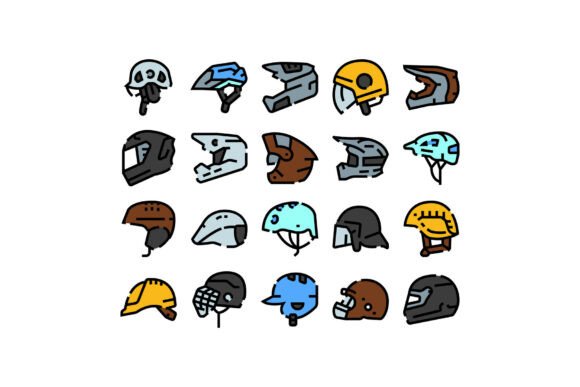
Whether you're designing a workplace safety campaign, building a sports equipment e-commerce interface, or developing an infographic about head injury prevention, visual clarity and accuracy matter. The Helmets Collection Featuring Various Saf is a purpose-built set of vector line illustrations—curated to represent real-world head protection across diverse contexts. It’s not just another generic icon pack. This collection delivers intentional, scalable, and context-aware helmet designs for sports, occupational safety, recreation, and public health communication.
Why Head Protection Visuals Matter More Than You Think
Clear, consistent visuals reduce ambiguity—especially when safety is involved. A construction worker scanning a training module shouldn’t pause to decipher whether an icon represents a bike helmet or a hard hat. Likewise, a UI designer building a mobile app for cycling routes needs instantly recognizable gear icons that align with user expectations. Misaligned or stylized illustrations can dilute trust, slow comprehension, and even compromise message effectiveness in high-stakes settings like emergency response guides or PPE compliance checklists.
That’s where the Helmets Collection Featuring Various Saf steps in—not as decoration, but as a functional design tool. Each illustration is grounded in real helmet typologies: full-face motorcycle helmets with visors, ANSI-compliant industrial hard hats with suspension systems, ASTM-certified bicycle helmets with ventilation patterns, climbing helmets with chin straps and adjustable fit systems, and even specialized variants like welding helmets with auto-darkening lenses or winter sports helmets with integrated goggle clips.
Solving Real Design and Communication Challenges
Designers, educators, safety officers, and content creators face recurring hurdles:
- Inconsistent visual language: Using mismatched or overly abstract helmet icons across documents, apps, or posters weakens brand cohesion and reduces scannability.
- Lack of contextual fidelity: A single “helmet” icon fails to distinguish between a firefighter’s thermal-resistant helmet and a skateboarder’s lightweight EPS-shell design—yet both serve critical, non-interchangeable roles.
- Scalability limitations: Raster-based or low-resolution images pixelate when enlarged for large-format signage or zoomed-in digital interfaces.
- Time-intensive customization: Manually adapting stock icons to match color schemes, line weights, or layout constraints eats into project timelines.
The Helmets Collection Featuring Various Saf directly addresses these issues. Built in clean vector format (SVG, EPS, AI), every helmet is fully editable—adjust stroke width, recolor in seconds, layer with text or data points, or integrate seamlessly into Figma, Adobe XD, or Sketch workflows. More importantly, the collection groups helmets by use case, making it easy to select the right visual for the right audience—no guesswork required.
Practical Applications Across Industries
This isn’t theoretical. Teams are already applying the Helmets Collection Featuring Various Saf in tangible, high-impact ways:
Safety Training & Compliance Materials
OSHA-aligned onboarding modules, multilingual PPE handbooks, and site-specific hazard maps all benefit from precise helmet representations. For example, pairing a high-visibility yellow hard hat icon with “Fall Protection Zone” labels reinforces protocol visually before workers read a word. The collection includes variants with harness attachments, ear protection add-ons, and reflective tape details—supporting nuanced safety messaging without cluttering layouts.
Sports & Recreation Platforms
Fitness apps, outdoor gear retailers, and youth sports associations use these icons to categorize equipment, illustrate proper usage, or signal risk levels. A mountain biking trail map might use a trail-rated helmet icon (with extended rear coverage and MIPS liner detail) next to technical descent sections—communicating expected gear far more effectively than text alone.
UI/UX and Dashboard Design
When building dashboards for fleet safety analytics or worker wellness programs, consistency matters. Instead of mixing clipart-style helmets with custom-drawn elements, teams use the Helmets Collection Featuring Various Saf to maintain uniform line weight, perspective, and visual hierarchy. One healthcare client reduced dashboard development time by 30% after standardizing on this set for their “PPE Adherence Scorecard.”
How Different Users Get the Most From This Collection
Your goals shape how you’ll use the collection—and that’s by design.
- Graphic designers appreciate the modularity: each helmet is isolated on a transparent background, grouped by category (e.g., “Work,” “Sports,” “Recreation”), and labeled with intuitive filenames like “helmet-hardhat-ansi-z89-1-2022.svg.”
- Educators and safety trainers rely on the anatomical accuracy—chin straps, ventilation placements, and shell contours help learners identify correct fit and function during demonstrations or printed handouts.
- Product managers and developers value the SVG compatibility and accessibility-ready structure (properly tagged paths, semantic grouping), supporting responsive web interfaces and WCAG-compliant documentation.
- Public health communicators use the clean, neutral aesthetic to avoid cultural or gendered assumptions—focusing instead on universal recognition and behavioral prompts (“Wear your helmet every ride”).
Key Considerations Before You Implement
While the Helmets Collection Featuring Various Saf solves many challenges, thoughtful implementation ensures maximum impact:
- Match icon to audience literacy: A detailed motorcycle helmet with aerodynamic vents may resonate with riders—but simplify to a silhouette with clear visor and chin strap for general public campaigns.
- Pair with action-oriented text: Icons alone don’t change behavior. Use them alongside concise directives: “Inspect straps weekly,” “Replace after impact,” or “Fit snug—no rocking.”
- Test for cultural resonance: In some regions, helmet colors carry meaning (e.g., white for medical responders, orange for road crews). Leverage the editable nature of the vectors to align with local standards.
- Avoid visual overload: Even with high-quality icons, limit helmet representations to one per section or concept. Prioritize clarity over quantity.
Finally, remember that design supports behavior—but doesn’t replace it. The Helmets Collection Featuring Various Saf strengthens communication, builds trust through accuracy, and saves time—but its greatest value emerges when paired with sound safety policy, accessible training, and consistent reinforcement.
If you’re evaluating visual resources for safety-related projects, ask yourself: Does this set reflect real-world usage? Can I adapt it quickly without sacrificing fidelity? Will my audience recognize it instantly—and act because of it? The Helmets Collection Featuring Various Saf was built to meet those questions head-on—with precision, purpose, and practicality at its core.